Wednesday, December 19, 2007

1000 steps up Guanzai mountain


Day 2 of our bus trip began early on the bus with a stand up comedy routine by our guide. I will give you a sample: "Deng Xiaoping (famous Chinese political leader) was visiting the US, but he doesn't speak any English. The interpreter left his side for a moment, but he was approached by a reporter, who asked "what are you going to see while you are here?" Not sure what to say, Deng introduced himself "Wo shi Deng" ("I am Deng" -- but sounds like Washington). Then the reporter asked -- "what are you going to do there?". Still not sure, Deng thought for a minute and decided to give his first name : "Xiaoping" (get it... sounds like"shopping?") You have to love bilingual puns. Not to be outdone-- Thomas walked up to the front of the bus to tell a joke of his own, to the delight (I think) of the passengers . Our first sightseeing stop was a lake near Guanzai shan, where we were treated to a scenic boat ride to admire the surrounding cliffs.

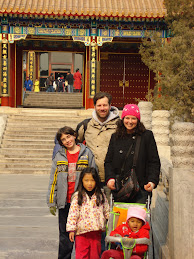
The xiao pengyou (little friends) of the trip.

I had to take a picture in the lobby of the restaurant where we had lunch. THE saddest Christmas tree ever...a dead branch stuck in a pot covered with cotton balls and a few decorations.

We began the ascent of the mountain in the afternoon, and everyone was dragging a bit except Sophia, who climbed about half the steps before being forced into the backpack.

It was steep climbing but fantastic views of the surrounding countryside, although a bit hazy.

Helen taking a rest 2/3 of the way up. I was really panting at points on this one.

Finally we reached the ridge with a fine view of the surrounding peaks.

The small pagoda at the top was our final destination. The last flight of stairs was just cut into the rock and with a sheer drop on each side, it was a challenge for me, but Helen wanted to go, and Michael had Sophia in the backpack, so I had to go ahead and just keep my eyes on the steps. It was so worth it once we got there!

Once again, Thomas is happy -- just trying to look cool:)

We agreed that this part of the path looks like a scene from The Lord of the Rings-- the "paths of the dead".

I was so proud of what good climbers the kids were on this day. I told Helen that I would take her anywhere in the world and she replied, "Good, because I want to ride on an elephant's head." Uh oh.

Back at the bus, our fellow traveler Jason was offering us a natural snack of some edible branches. Since he was a bio major in college, we went ahead and tried it -- tasted like apples.

Sophia takes a nap on a weary Daddy.

My last entry marked the 100 post mark. Thanks to everyone who has been encouraged us to keep writing by reading and commenting. A note on comments...the blogger help page can assist you with settings if you are having trouble commenting. Remember -- your comments will not appear immediately because they are sent to me first so I get a chance to read them before they are posted. Hope everyone back in the US is enjoying the holiday craze so far....

Monday, December 17, 2007

The Hakka toulou (round houses)


In south western Fuijian province, about 4 hours from Xiamen, is an area with a heavy concentration of Hakka people. They are not exactly an ethnic minority, but are a group of Han Chinese who had to migrate from the north of China about 1000 years ago and settled in Fujian province, where they were not always welcome, since farmland and other resources were scarce in this very mountainous area. Eventually they developed a style of building which is quite striking, using rammed earth and bamboo, as well as other home-grown materials such as glutinous rice to construct huge earth dwellings, most of them round (hence the term roundhouses). The University sponsored an overnight trip this weekend to see some of these buildings which are still in use by the local people. The first thing we were struck by was the enormous size...they can house entire clans together, up to several hundred people. They were built with no first floor windows "to keep out the tigers" according to the guide, and also to withstand hostile attacks by neighbors. Like all good tour groups, our first stop was lunch next door -- very simple local food, lots of pork, unidentified greens and some glutinous rice dumplings and sweets.

Also, its persimmon season and these were drying everywhere in the village, and being sold all over (we had just tried our first ones in Xiamen earlier in the week). Kind of like a sweet potato in flavor.


This was a wedding procession -- I am pretty sure it was staged for the tourists, but still colorful.

Inside the largest tulou, we found a lovely, peaceful atmosphere. The day was quite hot for December and we were all overdressed, but the tulou was cool. It has its own water supply by well, pictured above..with one well int the east and another in the west, which has some kind of fen shui significance. Our guide was very into the notion that the tulou have ideal feng shui, as well as natural heating and cooling because they are made of earth.

This large tulou was built in 1912, so it is quite new. It was built by a man who had become wealthy raising and trading tobacco. The interior was constructed beautifully of wood, and I found the circular interior very pleasing to the eye, and crying out to be photographed. The tulou is jointly owned by a group of relatives, and the guide said that since the tourists have begun to flow, competition for tourist money has disrupted the harmony of some of the extended families who live here. Also, many of the residents only spend a few weeks a year (usually at the Spring Festival) living in the village, because they need to pursue work in the cities.


We had the best time just wandering around this village. It is the off season for tourists, and we had the place pretty much to ourselves. This small shrine to a local deity was in the village square.

In the right background you can see the smallest of the four tulou in the village.

The river which ran through the village was really its defining feature. One of the other professors (an Australian marine biologist working to improve watershed health in China) on the trip remarked that it seemed to be a pretty healthy river by Chinese standards.

A woman was washing her green vegetables in the river and leaving them to dry along the bridge. We had lunch here so for her sake and ours I hope he was right!


One of the university staffers brought her 2 year old so our kids weren't the only ones.. they had a good time together, and my Chinese was just about on the two year old's level!


The focal point of the clearing in the village was a huge Banyan tree.

After a full day we were whisked away to a 4 star hotel in the big city of Longyan, about 90 minutes away. I was a little disappointed because we had seen a tulou set up as a simple inn where you can spend the night, and wanted to prolong the stay there...maybe we will go back again and do that.

Tomorrow I will bring you up to date on the rest of the trip -- 1000 steps up Guanzai mountain -- Sophia did about 500 of them herself!

Friday, December 14, 2007

Quick update

Not too much to report today, but Sophia had a very good day in potty-land, which means I will be able to get out of the apartment more again with a clear conscience soon! We picked Helen up at noon, which is my new plan for Fridays, as I feel like we never have time to sit and do any schoolwork, and I am attempting to keep her up with her class in the US. I got some new workbooks while I was in Michigan. On Friday afternoons the apartment is quiet, Sophia is napping and we had a full 90 minutes of work time and then time to start a craft (making felt people out of wool) before she woke up.

It was actually cold here today..63 or so and cloudy with a brisk wind. I can see that it will get quite chilly in the apartment with no heat on the cooler days ahead. Helen said she kept her coat on at school -- no heat there either and the "hallways" of the school are open air walkways.

Tomorrow morning early we set out on a brief overnight trip about 4 hours away in the Yongding area of the Fujian province (our province). The people here traditionally built large round dwellings made of rammed earth and glutinous rice! They apparently are quite large and would house entire clans. The best tidbit I heard is that the US government thought they were missile silos on satellite photography during the cold war. This is one of those must-see sights near to Xiamen, and the university is taking us, so we couldn't pass it up. I think we will also do some hiking in the mountains. Look forward to some photos when we get back!

Thursday, December 13, 2007

Michael Visits the Taoist Temple

Chapter Four of the Daodejing:

The Way is like an empty vessel;
No use could ever fill it up.
Vast and deep!
It seems to be the ancestor of the myriad creatures.
It blunts their sharpness;
Untangles their tangles;
Softens their glare;
Merges with their dust.
Deep and clear!
It seems to be there.
I do not know whose child it is;
It is the image of what was before the Lord himself!

Today I met my student Guo Jinjie, who has accompanied us on many trips, and we took a bus to the nearby Taoist temple.

Here you see the outer wall with the traditional yin-yang symbol that identifies it as Taoist.

Unlike the Buddhist temple next door to our residence, the Taoist temple doesn't get many visitors. In fact, we were the only people there besides the Taoists. Guo Jinjie says that while many Chinese are Taoist in a folk manner, they do not come to the temples for rituals as they do in the Buddhist temples.

Here is a nice shot of the temple front with the mountains in the background. The building to the right of the main shrine is where the Taoists live. There are five of them that live there.

Around back, we have this pretty amazing feature. It is the entire Daodejing carved into the side of the mountain. While Taoism as a folk religion is probably more than three thousand years old, the Daodejing is the central work of Taoist literature. It is said to have been written by Laozi and probably dates to the second or third century BC. The book is only 5000 characters, but still it's pretty amazing to see it carved into the mountain.

While the temple is about 500 years old, Guo thought that the carving of the Daodejing was only about 100 years old. Here is a slightly closer look at the characters along the lower right hand side of the work.

Like all traditional Chinese writing, it reads from right to left, and from top to bottom. So you begin in the upper right hand corner and read down the column to the bottom. Then you move to the next column to the left, start at the top and read down to the bottom again.

I thought that this dragon in the corner was worth a look.

This is the outer gate that leads to a complex of rooms in the old part of the temple. The red door beyond the gate leads to the cave that was the original dwelling of some Taoist monk centuries ago.

Here is the door to the cave. You can see that the cave is carved right into the mountain.

And this is the tiny cave room. I've been in it before. This time the door was locked so I put the camera through the barred window and snapped the picture. I don't know what it was like for the old Taoist back in the day, but he didn't have too much room spread out. However, a big principle of Taoism is to live in harmony with nature and the old monk would have had plenty of that out here.

Going back into the main temple, here is one of the many side altars with statues of various gods and offerings of fruit and other food and drink laid out on the table. There were about a half-dozen of these in the temple.

Below is a shot of the main altar. The supreme god is in the center with the white beard. You can see the Yin-yang sign above his head. There is also one on his garment. I can never remember his name. Much of this comes from old tales and folk practices. The gods protect people and can offer prosperity, longevity, and even immortality if things are done right.

Below is a shot of the Taoists performing the rites. We got there at about 4:40 pm because we knew that the rite started at 5 pm. There was no one there but the three Taoists, Guo and myself. The rites lasted for about 30 minutes. There was a lot of drumming at different tempos by the guy on the right. The guy in the center used several different chimes and a gong. While they were rhythmically drumming and chiming they were chanting at various different paces. Sometimes the chants were long slow refrains in which they held notes for a long time; at other times the chants were really rapid and they were reading scriptures at a quick pace.

The girl on the end was obviously in training, as she didn't do much chanting and looked lost much of the time. I did like that she had basketball shoes on under her robes. The main priest, on the right, was barefoot even though the floor was a bit cold as it was a windy night on the mountain.

After the rites, the Taoists invited us in for tea. They spoke no English (and I am not confident that they spoke Mandarin either). The two male priests looked to be in the their thirties. The young female Taoist looked to be in her early twenties. All were a bit younger than I had expected. They said that there were five of them living there, but as is often the case, some of them had to go and perform rites at somebody's funeral. They said that overall there are about fifteen different Taoists in the community who can come in and perform the ceremonies. They are held at 5 am and 5 pm every day.

Afterwards I asked Guo if the Taoists believed in the particular gods whose statues were displayed there, and he said that he didn't think that they did. They were Taoists of a more philosophical and literary sort, and they use the rituals to help learn the Taoist texts and to get in touch with heaven and earth. There is another Taoist shrine about one kilometer away that is a "local" shrine - meaning that it is dedicated to a local god recognized in that neighborhood only and that is maybe an older but more superstitious version of Taoism.

The trouble with water

So last night we were having dinner in the big on-campus restaurant. They have a menu in English, so it is usually reasonably smooth, although we once ended up with a dish featuring chicken feet and hot peppers which was completely inedible. The kids have been having too much pop lately so I wanted some water for them to drink. The fun began. Couldn't remember "mineral water" in Chinese, so I asked for shui (water) and motioned unscrewing a bottle. This has worked literally dozens of times. She brought hot water. So I said, "bu yao, yao shui bing" --I was pretty sure bing meant cold, plus I motioned shivering. So she brought a bowl of ice, to the great amusement of everyone at the table. I just kept saying shui and motioning that bottle top, and finally 2 bottles of water were produced !!! We noticed that often the other patrons are not drinking anything with their meals. Seems odd.

This whole meal was fraught with communication problems, even asking for the number of dumplings...she just did not recognize my pronunciation. Maybe she is a local speaker of Minnan for whom Mandarin is a far distant language? Or could my tones be so bad that she didn't recognize the number 15? I prefer to think it was her, not me!

Speaking of language learning..Helen's class is having a flag raising ceremony on Monday for the school (the classes take turns) As it turns out, Helen is one of 6 children chosen for a little speaking part, which she has been practicing. She says, in Chinese "Wo shi da san ban de Huan Huan xiao pengyou" (I am the Big Third class's Little Friend Huan Huan). It really pleases me that Helen's teacher is willig to put the extra time in with her and seeks out chances for Helen to develop her Chinese. Of course Helen loves to perform, so I'm hoping it will go well for her. Fear not, relatives, I will be video taping. Actually we have shot almost no video here, instead have focused on the still pictures... usually it is just too much for me to manage with both cameras and Sophia, but this occasion calls for as much technology as possible!

Tuesday, December 11, 2007

Thoughts on the lost holiday traditions of China

I was talking with a friend tonight, who commented on our Christmas preparations, and we got into a conversation about holiday traditions in China for the Spring Festival...Chun Jie (also known as Chinese New Year. We have been trying to get people to tell us where are the best places in China to see customs associated with Chinese New Year. In our minds, we are thinking about Lion Dances and fireworks, everyone dressed in silk outfits, you know, like Chinatown in San Francisco or New York. Michael's students have been stressing that usually only families gather together at home or in a restaurant. Our friend added that during the Cultural Revolution, the old traditions, the folk beliefs, and traditional customs were forbidden and considered dangerous thinking. He pointed out that when his parents' generation were children, these customs were mostly gone from mainland China. What remains are the traditional foods, and the giving of hong bao "lucky money" to children and unmarried young people. Families travel long distances to be reunited. He thought that in remote areas of China maybe some of the more colorful customs remain. One more example of the legacy of the "hidden" past of recent Chinese history casting its shadow.

Riding the "potty train" in China


Yes I am weird enough to post this picture on the blog -- hey there are grandparents out there reading this! We have to recognize Sophia's big milestone, after all -- her first day of potty training. Not too bad really -- we located a suitable potty chair and pulled out one of her Christmas gifts early ("Once Upon a Potty" - thanks to Aunt Mary) and five minutes after we got home she had had her first (and regrettably, only) success of the day. Some challenges of this process are going to be our mobile, pedestrian lifestyle, and the high cost of pull ups (twice as much as diapers), not to mention the dire condition of most public restrooms, but on the plus side -- its not my carpeting and toddlers are running around in spilt pants peeing on the sidewalk anyway (see previous posts on split pants -- hey maybe I'll get some!) And she does seem somewhat ready -- verbal, dry for long periods and naps, convinced she is a big girl, etc. The Chinese do this very young-- beginning really in the first year when the caregiver learns to read the baby's signals and position them accordingly. So by 18 months they are done and pretty self sufficient. Sophia is big for a 2 year old here and the oldest child in China still wearing diapers, and she is right at the upper edge of the largest size -- so the die is cast! Helen's tutor was completely entranced by "Once Upon a Potty" with its cute, yet graphic illustrations of the process and to quote-- "we would never have this book!"

This is all part of my master plan to wheedle Sophia's way into the nursery school on campus a few mornings a week next semester. She misses the birthday cut-off by 3 weeks, but if I can just get her toilet trained I think they would maybe work around that. I am itching to enroll in a more intensive Chinese course, but would surely need more time to do it than Michael can really spare, so we'll see what unfolds.